

Keyword research has always been the foundation of SEO success. But in 2026, AI tools have transformed the way marketers discover profitable keywords. Instead of manually digging through data, you can now use AI prompts for keyword research to generate keyword ideas, analyze search intent, and uncover low-competition opportunities within seconds.
Whether you’re a blogger, SEO specialist, or content marketer, the right AI prompt can turn tools like ChatGPT, Claude, and Gemini into powerful keyword research assistants.
In this Article, you’ll learn the best AI prompts for keyword research, how to use them effectively, and how to integrate them into your SEO workflow.
Why Use AI Prompts for Keyword Research?
Traditional keyword research tools are still useful, but AI offers several advantages.
Benefits of AI-driven keyword research
- Generates hundreds of keyword ideas instantly
- Helps identify search intent
- Finds long-tail keywords
- Builds topic clusters
- Speeds up content planning
AI prompts work best when combined with SEO tools such as:
AI provides ideas, while these tools validate search volume and competition.
How AI Prompts Improve Keyword Research
When used correctly, AI prompts for keyword research help you move beyond simple keyword lists.
AI can help you:
- Discover content gaps
- Generate topic clusters
- Identify buyer-intent keywords
- Create SEO content outlines
- Predict search intent
This means you can create better SEO strategies faster.
20 Best AI Prompts for Keyword Research
Below are some of the most effective prompts used by SEO professionals in 2026.

Generate Seed Keywords
Prompt:
Act as a professional SEO strategist. Generate 30 highly relevant seed keywords related to the niche “[YOUR NICHE]”. Focus on common search phrases people type into Google. Ensure the keywords are clear, realistic, and useful for SEO research.
Example niche: Digital marketing
Output example: digital marketing strategies, online marketing tips, SEO marketing techniques
Find Long-Tail Keywords
Act as an advanced SEO expert. Generate 50 long-tail keywords related to “[YOUR TOPIC]” that have strong search intent and are easier to rank for. Focus on keywords typically used by real users in Google searches.
Why this works: Long-tail keywords often have higher conversion rates and lower competition.
Identify Search Intent
Act as an SEO specialist performing keyword research. Generate 25 low-competition keywords related to “[YOUR TOPIC]” that a new website could realistically rank for in Google search results.
Understanding intent helps you match the right content to the right audience.
Find Low-Competition Keywords
Act as an SEO keyword strategist. Generate 30 question-based keywords related to “[YOUR TOPIC]” using formats such as how, what, why, where, and best. Focus on queries people commonly search on Google.
This is extremely useful for new blogs and niche sites.
Search Intent Classification
Act as an SEO analyst. Analyze the following keywords and classify them into search intent categories: informational, navigational, commercial, and transactional. Provide the results in a clear table. Keywords: [PASTE KEYWORDS HERE].
Topic clustering helps build topical authority.
Blog Topic Ideas
Act as an SEO content strategist. Generate 20 blog post ideas based on the keyword “[PRIMARY KEYWORD]” that have strong ranking potential on Google and align with user search intent.
Examples:
- How to use AI for keyword research
- What are AI keyword prompts
- Can ChatGPT do keyword research
Keyword Clustering
Act as an advanced SEO strategist. Group the following keywords into logical topic clusters to improve SEO topical authority. Provide cluster names and the keywords within each group. Keywords: [PASTE KEYWORDS HERE].
Topic clustering helps build topical authority.
Buyer Intent Keywords
Act as an SEO and marketing strategist. Generate 20 high-intent commercial keywords related to “[PRODUCT OR SERVICE]” that indicate a user is comparing products or preparing to purchase.
Examples: Best AI SEO tools, AI keyword research software, SEO AI tools pricing
Competitor Keyword Ideas
Act as a competitive SEO analyst. Generate keyword ideas that competitors in the “[INDUSTRY]” niche are likely targeting, but many smaller blogs might overlook. Focus on realistic SEO opportunities.
Local SEO Keywords
Act as a local SEO specialist. Generate 25 local search keywords related to “[SERVICE]” targeting users searching in “[CITY OR COUNTRY]”.
Content Gap Keywords
Act as an SEO expert performing content gap analysis. Suggest 20 keywords related to “[TOPIC]” that are underserved by current Google search results but have strong informational demand.
Trending Keywords
Act as a digital marketing trend analyst. Generate 20 trending keyword ideas related to “[INDUSTRY]” that are likely to grow in popularity over the next 12 months.
Affiliate Keywords
Act as an affiliate marketing SEO expert. Generate 20 keyword ideas related to “[PRODUCT CATEGORY]” that have strong buying intent and work well for affiliate content.
Comparison Keywords
Act as an SEO strategist. Generate 20 comparison keywords related to “[PRODUCT OR TOOL]” such as product comparisons, alternatives, and “X vs Y” type search queries.
Featured Snippet Keywords
Act as an SEO expert focused on featured snippets. Generate 25 keyword ideas related to “[TOPIC]” that are likely to trigger Google’s featured snippet results.
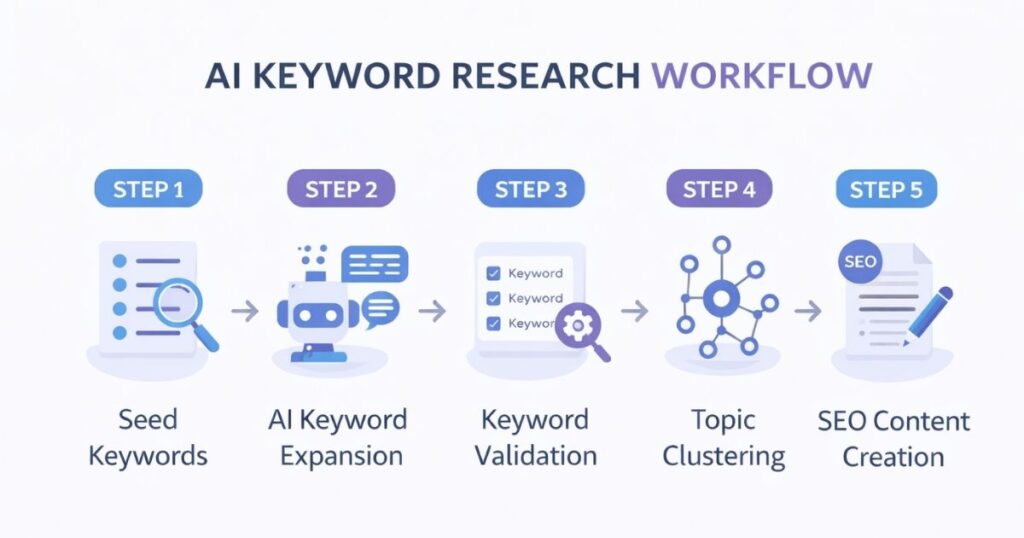
Example Keyword Research Workflow Using AI
Here is a simple workflow combining AI prompts with SEO tools.
| Step | Action |
| 1 | Generate seed keywords using AI |
| 2 | Expand long-tail keywords |
| 3 | Validate search volume with SEO tools |
| 4 | Group keywords into topic clusters |
| 5 | Create content outlines |
This process can reduce keyword research time by 70%.
Best Practices for Writing AI Prompts
Not all prompts produce useful results. Use these best practices:
Be specific
Good prompt: Generate 30 long-tail keywords related to AI prompts for keyword research with low SEO difficulty.
Bad prompt: Give keyword ideas.
Provide context
Mention: niche, audience, intent, location
Ask for structured output
Example: Present the results in a table with keyword, search intent, and content idea.
Common Mistakes When Using AI for Keyword Research
Avoid these common SEO mistakes:
- Blindly trusting AI keywords: Always validate using tools.
- Ignoring search intent: Ranking depends on intent matching.
- Targeting overly competitive keywords: Focus on long-tail keywords first.
- Not building topic clusters: Google favors topical authority.
FAQ Section
What are AI prompts for keyword research?
AI prompts for keyword research are instructions used with AI tools to generate keyword ideas, analyze search intent, and discover SEO opportunities for content creation.
Can AI replace keyword research tools?
AI cannot fully replace keyword tools, but can speed up idea generation and strategy planning.
Which AI tools are best for keyword research?
Popular tools include: ChatGPT, Claude, Gemini, Surfer AI, Jaspe
Are AI-generated keywords accurate?
AI can generate useful keyword ideas, but they should always be verified using SEO tools for search volume and competition.
Conclusion
AI is changing the future of SEO, and mastering AI prompts for keyword research can give you a huge competitive advantage. With the right prompts, you can discover profitable keywords, build topic clusters, and create SEO content faster than ever.
However, the best strategy is to combine AI creativity with traditional SEO tools to validate data and competition.
Start experimenting with these prompts today, and you’ll unlock powerful keyword opportunities that most marketers are still missing.